Twenty Thousand Leagues Under the Sea by Jules Verne


Twenty Thousand Leagues Under the Sea
Jules Verne
(Puffin Classics: 1995)

First published in French in 1870.

READ: September-November 2006

A 19th-century classic. Through a strange twist of fate, Professor Aronnax and two companions, his man-servant Conseil and a French Canadian (!) harpooner (whaler) called Ned Land, journey to the deepest, darkest depths of the sea with the elusive Captain Nemo on his fantastic submarine, Nautilus. It's a fantastic journey, but the reading is not for those who want their stories told quickly: the Professor is a noted marine biologist, and he wastes no opportunity to minutely detail every creature of the sea that he encounters.

However, the story itself is entertaining, and while I don't know Verne's background (nor have I read anything else by him - an oversight I should correct someday), I admire the level of work and research that must have gone into the writing of this tale. While submarines did exist when Verne wrote this, many of the features of Nautilus were not yet possible, and his imagination has to be admired. Finally, I found the political vision of Captain Nemo, a man who has turned his back on most of mankind, to be fairly un-Victorian, giving the book an interesting resonance for contemporary times (at least for me). Besides, if nothing else, this book was worth reading just to see how the 19th-century French viewed their provincial Canadian cousins.

Lost Japan by Alex Kerr


Lost Japan
Alex Kerr
(Lonely Planet Publications, Australia: 1996)

First published in Japanese in 1993 as Utsukushiki Nippon no Zanzo (Shincho-sha, Tokyo). Translated by the author Alex Kerr in 1996 for the Lonely Planet Journeys series.

READ: November 2006

Along with Alan Booth's books, Lost Japan is lauded pretty much everywhere as one of the best books ever written about Japan.

I agree. I couldn't put it down.

My recommendation: Read this book.

There's really not much more I can say. It's just a wonderful book. Even for those who are not Japanophiles, this book can be appreciated on many levels. Yes, it is about Japan and the Japanese, and was written by a man who has lived most of his adult life in Japan. A memoir of sorts, it is a story about looking for beauty, a beauty whichi happens to exist in Japan but is rapidly disappearing as Japan continues stumbling blindly forward to the future.

As a side-note, this book was originally written in Japanese, and Alex Kerr was the first foreigner to win the prestigious Shincho Gakugei Literary Prize of Japan in 1994 for it.

The Adventure of English: The Biography of a Language by Melvyn Bragg


The Adventure of English: The Biography of a Language
Melvyn Bragg
(Hodder & Stoughton, Great Britain: 2005)

READ: September-November 2006

I kept seeing this book in the English-language section of one of the bookstores in nearby Nagoya, and finally I had to buy it. And man, what a compelling read!

As the title suggests, Melvyn Bragg has set out to give us a history of the English language. But far from being dry and pedantic, he has a humorous, often light-hearted twist on the story. He gives further details where needed, and glosses over other parts of the story when they are not key to the advancement of the telling. (A skill I sorely lack.) The result is a thoroughly entertaining read about an important movement in history - the development and entrenchment of the English language across large swathes of the world.

Obviously, this book is a little Euro- ethnocentric, but, well, it is about the English language specifically (not just language in general), so that's hardly avoidable. While he sometimes explodes into overblown grandeur, overall Bragg does a good job of recognizing his bias (and, indeed, the bias of the language itself).

This book is apparently at least based in part on a television documentary (I think for the BBC) that Bragg did a few years earlier, but that's all I know.

Why I Hate Canadians by Will Ferguson


Why I Hate Canadians
Will Ferguson
(Douglas & McIntyre Ltd., Vancouver: 1997)

READ: July-September 2006

In this book, Will Ferguson (one of my favourite Canadian authors) takes a mostly-humorous, somewhat-serious look at what it means to be Canadian. Far from being a boring political study, he draws personal anecdotes and other strange stories, in an attempt to examine his own attachment or connection to "Canada" and "Canadianness".

Before continuing with my review, however, I feel obliged to mention, in the interests of full disclosure, that I read this book on the plane to, and immediately after arriving in, Japan, while Will Ferguson wrote this book pretty much immediately following his return to Canada after many years of living and teaching in Japan. That is to say, there might just be some weird alignment of the stars which caused me to enjoy this book. Or it is simply a good book. I still haven't figured out which.

Though he makes many sweeping generalizations about the whole mess we like to call "Canada", I found him to be, more often that not, fairly on the mark. Through his political musings and wanderings, Ferguson attempts to pin down why Canadians are what they are (what makes us tick) and also what personally keeps him going as a Canadian. In particular, I had a hearty laugh at his exposure of the Canadian Dream (success without risk) and the three Great Themes (keeping the Americans out, keeping the French in, and trying to get the Natives to somehow disappear).

Sometimes funny, often tongue-in-cheek, while it doesn't provide as many belly laughs as the other books I have read by him, I'd recommend this if you're into books about Us.

Lonely Planet City Guide to Kyoto


Lonely Planet City Guide to Kyoto
Chris Rowthorn
3rd edition
(Lonely Planet Publications, Australia: 2005)

READ: July-August 2006 (and ongoing reference)

Yes, I like Lonely Planet guidebooks. And yes, you know exactly why I bought this book. Anyway, we used it thoroughly when we went to Kyoto in August, and we plan on going back once or twice in the next few months, so I feel I got my money's worth. (Heck, even if I had never gone to Kyoto, it was worth every penny - it's interesting, informative, and has pretty pictures.) It's fairly extensive, covering pretty much anything you might be interested in seeing in Kyoto, and there's a lot! There are also short sections on things to do in Nara, Osaka, Kobe, and Miyama-cho (a small town north of Kyoto), as each is an easy day-trip from Kyoto.

Harry Potter and the Half-Blood Prince by J.K. Rowling


Harry Potter and the Half-Blood Prince
J.K. Rowling
(Bloomsbury, London: 2005)

READ: August 2006

Ah, the always irrepressible Harry Potter and his gang. Yes, I managed to wait many months before reading the latest instalment. In fact, it was one of the few English books at my school's library, so I felt compelled to borrow it.

I have kind of enjoyed the Harry Potter books thus far, and this one was the same. At times, I found it hard to put down, and at others, looked for a fast-forward button. Don't even get me started on the movie versions of these books, but J.K. Rowling, while a good, entertaining writer overall, could do with a bit more editing sometimes. Anyway, Harry and his friends get up to more hijinks - some of them are fun, some make you shake your head and roll your eyes. It was a good read, and I have to say I am anxious to read the next one to see how it will all end!

2006 Booklist (Part 2)

books from my japanese bookshelf

  1. Harry Potter and the Half-Blood Prince by J.K. Rowling

  2. Why I Hate Canadians by Will Ferguson

  3. A Brief History of Time: From the Big Bang to Black Holes by Stephen Hawking

  4. The Adventure of English: The Biography of a Language by Melvyn Bragg

  5. Lost Japan by Alex Kerr

  6. Twenty Thousand Leagues Under the Sea by Jules Verne

  7. The Book of Ikebana by Kawase Toshirou

  8. Dogs and Demons: The Fall of Modern Japan by Alex Kerr (unfinished)

  9. A Crack in the Edge of the World by Simon Winchester

  10. Howl's Moving Castle by Diana Wynne Jones

  11. Things Not Seen by Andrew Clement

still waiting:

constant companions:
  • Lonely Planet Guide to Japan

  • Lonely Planet City Guide to Kyoto

  • Japanese for Busy People (Kana Version) by the Association for Japanese Language Teachers

  • How to Tell the Difference Between Japanese Particles: Comparisons and Exercises by Naoko Chino

  • Japanese Verbs and Essentials of Grammar, 2nd ed. by Rita L. Lampkin

  • Basic Kanji Book, vol. 1

  • Minna no Nihongo I

  • How to Teach English by Jeremy Harmer

  • TESL Certification Course: Training Manual prepared by Oxford Seminars

  • Handbook for Team-Teaching, rev. ed. prepared by the Japan Ministry of Education, Culture, Sports, Science and Technology

  • Resource Materials and Teaching Handbook prepared by the Japan Council of Local Authorities for International Relations

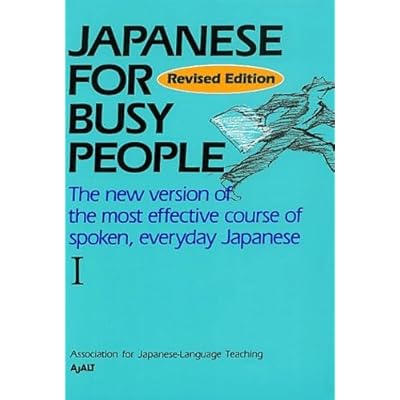
Japanese for Busy People by the Japanese Association of Language Teachers


Japanese for Busy People (Books 1&2 and Kana Workbook)
Japanese Association of Language Teachers
(Book 1 - Oxford University Press, USA: 1995; Book 2 - Fitzhenry & Whiteside: 1996)

Read: from May 2005 onward (I still use Book 2 regularly)

When I first started wanting to learn Japanese over a year ago, Randal lent me his old text, Japanese for Busy People (Book 1), that he'd used when he'd started Japanese lessons many years before. So I was quite pleased when the Japanese course that I took at Algonquin turned out to use the same text as well!

Book 1 is really well-organized. It has short, concise lessons that introduce a few grammar points and some vocabulary, then many exercises to get you using, learning and really remembering what you have learnt. Book 2 is slightly more unwieldy, but still good. It has more grammar and vocab in each lesson, and I find the order in which it is all introduced - thematically (eg., At Work, At the Health Club, etc.) rather than by grammar topic - to not always be intuitive. Plus, I bought the kana version, which is good for practicing my hiragana and katakana practice, of course, but makes reading slow! That will improve with practice, I know.

I also picked up, somewhere along the way, the Kana Workbook for the Japanese for Busy People series. It was VERY useful for practicing katakana and hiragana and really getting them to stick in my head. Now if only they produced a book to teach me, equally simply and painlessly, the 1,945 kanji designated necessary by the Japanese government.

Watership Down by Richard Adams


Watership Down
Richard Adams
(Avon, New York: 1975)

READ: May-July 2006

This is one of those books that it felt like everyone else read in high school (or saw the movie of) except for me (that, and The Hobbit). I borrowed the book from Randal's endless bookshelf.

If you've only seen the movie and have not read the book, READ THE BOOK. It is wonderful. It is the story of Hazel and his brother Fiver and some other rabbits from his warren who strike off on their own into the unknown larger world after Fiver, who has a sense for these sorts of things, feels impending danger coming to the warren.

Definitely not a book just for children, Watership Down is a larger tale of environmental destruction and a study of societies. It's very, very good.

Tokyo: A Certain Style by Kyoichi Tsuzuki


Tokyo: A Certain Style
Kyoichi Tsuzuki
(Chronicle Books, 1999)

Karin Goodwin is often listed as the author. Perhaps she translated? (Original photos and text are Tsuzuki's.)

READ: March-July 2006 (intermittent)

What a fascinating little book. We found it on one of the bargain shelves at Chapters, and it quickly became a permanent fixture in the washroom (only the best books are reserved for the "throne" at our place). This is a long way from Zen gardens and stripped-down, bare interiors. Instead, Kyoichi Tsuzuki took many candid shots of people's apartments in order to show how Tokyoites really lived. And how do they live, you may ask? Well, according to this book, they live in tiny little spaces sometimes barely deserving of the word "room", and they fill these spaces with stuff, stuff, and more stuff. It was just insane to see how some of these places were just filled to the rafters - and beyond! To be fair, many of the people whose places were profiled were artists and other such occupations in which much "stuff" is often accumulated. But it's a crazy read, loads of fun, and really really really interesting to see.

Quirky sidenote: I don't have the book handy* so I can't give you an exact quote, but in Wrong About Japan, Peter Carey makes a reference to a book showing how Tokyoites fill their homes with stuff. He describes the book at some length, without actually mentioning it by name. But there is no doubt that this is the book he meant!

* It's sitting in a storage locker in Ottawa, halfway across the world from where I am currently writing this. That excuse should hopefully be good enough.