Showing posts with label popular science. Show all posts

The Man Who Mistook His Wife for a Hat: And Other Clinical Tales by Oliver Sacks


The Man Who Mistook His Wife for a Hat: And Other Clinical Tales
Oliver Sacks
(Touchstone, New York: 1998)

Many of the case studies previously published in similar forms, starting in 1970 and through 1984 (when book was first published).

READ: April 2008

This was an interesting read, with some truly fascinating stories of people with various mental disorders. Dr. Sacks has been working with patients with neurological disorders for a very long time, so he has many stories to tell.

While I enjoyed the book on the whole, I found it a little unsatisfying, however - I wanted more in terms of neurological explanations and perhaps even a word or two about the philosophical side of neurological disorder (which Dr. Sacks kept alluding to but never going into more detail about). For the majority of the stories, Dr. Sacks just states the facts of the case, makes one or two observations, then moves on... I understand that it was not always possible to follow-up with the patients, to see perhaps how a particular type of treatment was working out, but it felt a little too much like I'd sat down with him in a bar and now he was telling me story after story without a chance for me to get a word (or question) in edgewise: "Here's an interesting story ... Here's another one ... What about this guy? ... It makes you wonder about what it really means to be human doesn't it? But enough about that already, how about this case here?"

So overall: Interesting, but if you were hoping to get some insight into how the human mind works or a bit of an understanding for why a certain disorder may or may not develop, you'll have to look elsewhere.

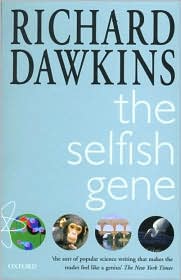
The Selfish Gene by Richard Dawkins


The Selfish Gene
Richard Dawkins
(Oxford University Press, Oxford, New York: 1989)

First published by Oxford University Press in 1976. This edition, 1989, with extensive endnotes updating the original material, as well as two new chapters.

READ: March-April 2008

Why does Richard Dawkins get such a bad name? His name is constantly being bandied about, and now that I've finally read something of his, it's a bit unfair, I think. This is an exceptional book, and really cleared up a lot for me regarding genetic theories and evolution.

I think the thrust of the misunderstanding of Dawkins, at least in regard to this book, is that people misinterpret (whether purposely or not) what he means by a "selfish gene". He doesn't believe that any one particular gene, sitting inside my body right now, is so selfish that it will do whatever it can to perpetuate itself. We would have gone extinct long ago were that the case. Obviously there is a reason that life on earth is so varied. Rather, and I am sure I am oversimplifying it here to such a degree that Dawkins would probably no longer agree with me, genes act selfish on the class level. It is classes or groups of genes that are selfish, not individual ones. And because they are selfish, they try to find the best ways to perpetuate themselves, but at the macro- not micro-level, if that makes any sense.

It's a bit daunting at first, but once you get going, his style is clear, simple, and immensely readable. It's a complex subject, but he's not afraid to take time with it and give good, concrete examples of each point. Somewhat amusingly, since this particular edition is a 1989 update of the 1976 original, he has added extensive footnotes that counterpoint arguments that have been made against his theories. He also - and this is one of the marks of a good scholar - is quick to note where his theories have since been proven incorrect, and often takes a page or two or more to elaborate a different or a concurrent theory to replace the old, incorrect one. This is probably one of the more enjoyable books that I've read so far this year.

Next by Michael Crichton


Next
Michael Crichton
(Harper (HarperCollins), New York: 2006)

READ: February 2008

I didn't have quite the visceral reaction to this book as I did to The Da Vinci Code, but almost. My mom left this book behind after coming to visit one weekend, and so I figured I'd read it.

In his book, Crichton states that Next is a work of fiction, "except for the parts that aren't." He then leads the reader through a dizzying whirlwind of genetic science events. A drug addict is cured by a gene therapy that causes accelerated maturity. A cancer patient who donated some of his cells for gene therapy to a university loses control over those cells, and those of his descendants. A monkey-boy is created when a researcher injects some of his sperm into an ape. You dream it up, Crichton's probably already put it in his book.

According to a review in the New York Times, "oddity after oddity in 'Next' checks out, and many are replays of real events." To which I respond, "Sure, but so what?" Just because something is true, doesn't make it worth reading. I've studied enough law and read just enough science to know that certain genetic procedures are still currently operating in a Wild West as far as patent law is concerned. I even agree that some, if not all, of these developments are troubling. But if you're trying to bring the issue to the forefront, why not do so in a less tabloid-esque way?

And that, I guess, is my main problem with this book. Fundamentally, I can agree with Crichton's main thesis. A novel with a thesis, you may ask? While certainly not every work of fiction can be said to have a central thesis, in an Author's Note to Next, just in case you didn't "get it", Crichton clearly lays out his five conclusions:

1) Stop patenting genes.
2) Establish clear guidelines for the use of human tissues.
3) Pass laws to ensure that data about gene testing is made public.
4) Avoid bans on research.
5) Rescind the Bayh-Dole Act [which grants universities, small businesses, and non-profit institutions in the U.S. the control and ownership of any intellectual property on inventions resulting from federal government-funded research, rather than the IP rights going to the government].

On their face, these are laudable goals. And a novel, of course, does not have to be neutral in its politics. However, I find Crichton's method of hammering the reader over the head with example after example of why our current legislative scheme (or lack thereof) is faulty, to be tedious, deplorable, and even somewhat insulting. Next is geared to prove that these five conclusions are inevitable. While this may or may not be true, a proper exploration of the issues would have been more appropriate. A proper exploration could very well, in fact, lead to the same five conclusions, but without me feeling like I've been dragged through 300+ pages of bias to get there, leaving me a happier reader as a result, and perhaps more concerned about the issues.

But Next dismisses any need for a proper debate. It says, "It's so obvious," and then throws 37 different examples my way. It portrays the guys (yes, mostly guys) in the biotechnology business as cowboys, bent on getting the results they want at any cost. Everything is black and white. Even those issues that could have been dealt with more subtly are painted with fat brushstrokes: Alex - whose father is the cancer patient mentioned above whose cells, and those of his descendants, are now "owned", as it were, by the university who developed a particular gene therapy - is a lawyer. But wait! - she's not a blood-sucking, money-leaching lawyer, like all the others in the book. She is nice and cuddly, and prefers to settle matters out-of-court whenever possible, rather than dragging everything out into a prolonged court fight. She only starts to get mean when her son is threatened. I mean, c'mon - it's her son! And then there's David, the 4-year-old "monkey-boy", who is rescued by the researcher who created him when it turns out David is scheduled for termination (due to the lab being worried about the ethical ramifications that may arise if David's existence is discovered, though why that hadn't happened earlier when David first started showing signs of being anything other than a regular ape is a good question, but I digress). He is brought to live with the researcher's family in California, and things only come to a head when another young boy starts challenging David. But this boy is not just your average neighbourhood bully, not just that kid who didn't get enough hugs from his mother when he was very young - oh, no, this kid is mean, escalating from a brief schoolyard scuffle to an actual gunfight in the blink of an eye. Shed no tears for the bully; David needs them all.

Crichton dumbs down the issue by using such broad, obvious strokes. In addition, the style of the book, with its short, fast-paced chapters, cutting from storyline to story line, and interspersed fake news articles written to look as if they are real, further debases the actual importance of these issues. Really, all I ever needed to know about cloning, I did not learn from Jurassic Park (to be fair, I have not read the book), and I am dismayed at the thought that people will think they have "learned" about genetic testing from Next.

Final thought: For an example of how to rewrite Next - even in such a way that it has almost exactly the same plotlines - but with less bias and more exploration of actual issues rather than the panic-stricken tone adopted here, take a look at Neal Stephenson's Cryptonomicon. In it, Stephenson clearly and concisely sets out the history of cryptography, and also explores future possible developments of the technology of cryptography, both good and bad. It's a big book, and will take you longer than 3 days to read (which is roughly how long it took me to get through Next, mostly while commuting to and from work), but there are certainly worse things on which you could waste brain-cells and time.

A Short History of Nearly Everything by Bill Bryson


A Short History of Nearly Everything
Bill Bryson
(Anchor Canada (Random House), Toronto?: 2004)

READ: November 2007

I'd been wanting to read this book for months now, and boy, was it worth the wait. In his Short History, Bryson explains everything from the beginnings of life on our planet, to astrophysics, natural disasters, dinosaurs, and Einstein's theory of relativity, in plain, simple language. Well-known as a travel writer, Bryson brings his particular brand of humour to these, and many other questions of scientific import. Entertaining and elucidating, it's one of those books I should have taken notes on while reading. Well-documented, and well-thought out, this is one of the most entertaining and informative reads I've had in a while. My first Bryson book, but definitely not my last.

Krakatoa: The Day The World Exploded: August 27, 1883 by Simon Winchester


Krakatoa: The Day The World Exploded: August 27, 1883
Simon Winchester
(HarperCollins, New York: 2003)

First published by Viking, Great Britain: 2003.

READ: July-August 2007

I've said this before, and I'll say it again: Winchester could make the phone book interesting, I swear.

While not quite as entertaining as A Crack in the Edge of the World, Krakatoa is a fascinating look into the insides of this infamous Indonesian volcano, and the devastation it wrought over 100 years ago. As a trained geologist, Winchester knows what he's talking about, and as a trained journalist, he knows how to make his story interesting. The story was hard to initially piece together, and Winchester has done a formidable job. It was the first modern volcanic explosion of such a ferocious magnitude. Vulcanologists (yes, they are really called that) didn't really exist yet, and those geologists who did have an interest in volcanoes didn't really know what made them tick. There were also very few survivors, and virtually no eyewitness accounts. Furthermore, while very few people actually died as a direct result of the volcanic explosion itself (Krakatoa was a volcanic island unto itself, so there was no Pompeii villagers waiting to be buried), the death toll skyrocketed after a series of devastating tsunamis hit the surrounding Javan and Sumatran shores. We don't even understand tsunamis today, let alone back in 1883. Beyond the actual devastation, of course, is the science of why it all happened - why did Krakatoa explode? - and that is where Winchester, like he did in A Crack in the Edge of the World, truly shines. If plate tectonics and the inner workings of the mantle core had been presented to me in such an interesting manner back in my early school days, I might have chosen a quite different career.

A Crack in the Edge of the World by Simon Winchester


A Crack in the Edge of the World: The Great American Earthquake of 1906
Simon Winchester
(Penguin Books, London: 2006)

First published by Viking in 2005.

READ: December 2006 - January 2007

There is no need to be an avid earthquake junkie to enjoy this book,* though it would be fair to say a passing interest in natural disasters helps. Former journalist Simon Winchester, who is trained in geology, has written an intensely compelling account of the famous 1906 San Francisco earthquake.

The earthquake was simply devastating. Striking early in the morning on April 18, 1906, it reduced a large part of San Francisco, one of the United States' most vibrant cities, to rubble. And what the earthquake did not destroy, the widespread fires that subsequently broke out finished off. Many thought the city would not be able to rebuild, but within a few months, it was back on its feet.

This is not just a social history of the people of San Francisco, detailing how peoples' lives were interrupted by the earthquake. While that in itself might be interesting enough, it certainly would not be adequate to sustain my interest for ~400 pages. Instead, in addition to bringing the 1906 earthquake and its reluctant participants to vivid life, Winchester also takes us on a fascinating geological tour. To research this book, he in fact traveled from just outside Albany in New York State, and straight across the southern United States to California. He then continued his travels northwards, through British Columbia up to Alaska (which is frequently hit by large quakes), and then back down through the Rockies and across the North American plain to his starting point in New York State. Along the way, he visits some of the most important geological hotspots, and tells us about their most interesting histories. Who knew, for instance, that a little tiny town in Missouri has suffered tens of thousands of earthquakes in the years since it was rocked by some quite violent ones in 1811, and that someday (in another 100 years or so) it will be hit by more big ones? Also, have you ever stopped to think that Yellowstone Park's Old Faithful is really just biding its time before, one day, it will turn into a super-volcano?

Set against the backdrop of the 1906 earthquake itself, Winchester tells us about these quirks of geology, and also takes us on a fascinating tour through the history and world of earthquake science, plate tectonics. This book should be called "Earthquake Science for Dummies (and It's Interesting, Too!)". Winchester knows his subject, and he gives just enough of a personal touch to every part of his subject (throwing in anecdotes, etc.) that what ought to be dry geological theories become quite interesting.

In fact, I suspect Winchester could make the phone book sound interesting.

* Unlike your beloved reviewer.

A Brief History of Time: From the Big Bang to Black Holes by Stephen Hawking


A Brief History of Time: From the Big Bang to Black Holes
Stephen Hawking
(Bantam Press, Great Britain: 1988)

With an introduction by Carl Sagan.

READ: September - December 2006 (intermittent)

This is not a big book (185 pages), but in it, Stephen Hawking covers a massive amount of ground. Starting from the Greeks, and running through Newton all the way to Einstein and beyond, Hawking attempts to outline for us, the non-science-y people, that area of physics that explores questions of time and space and, most importantly, the search for a theory that would explain it all. The meaning of life in one sentence (or rather, since it is physics, one equation).

I won't pretend I even begin to understand everything he talked about (in fact, the truth is far from that), but it is a fascinating read. Though a little tough and dry at times, Hawking generally does a good job of explaining concepts. A piece of advice for those who want to read it: Rather than reading it in dribs and drabs over a few months like I did, read it in as concentrated a period of time as you can. I want to re-read this book again at some point in the next year or so, and do exactly that - I think that way I'll get a better understanding of it.

Collapse: How Societies Choose to Fail or Succeed by Jared Diamond


Collapse: How Societies Choose to Fail or Succeed
Jared Diamond
(Viking, New York: 2005)

READ: February-March 2006

I read Jared Diamond's book Guns, Germs, and Steel almost exactly one year ago and really enjoyed it. Collapse was one I'd been seeing around a lot, so it was time to tackle it. And it did not disappoint. Guns, Germs, and Steel is the better of the two, but Collapse is also worth a read.

The book is a series of case studies of environmental degradation, and the ways in which the societies affected did or did not overcome these collapses. Guns, Germs, and Steel looked at the winners in civilization; Collapse looks largely at the losers: the Vikings, the Easter Islanders, the Anasazi of the American Southwest, the Mayans, modern-day Rwandans, and so on. But he also looks at societies that managed to overcome their environmental difficulties; for example, the Icelanders. Iceland is an environment that should not work, yet it is one of the most prosperous nations in the world. Why?

Diamond's basic argument, to really dumb it down, is that not all failures of societies can be blamed on a cataclysmic event, on an act of God (or whoever), but that many times, a society fails because it does not respond appropriately to the environment around it. So the Vikings, for example, tried to live in Greenland in exactly the same fashion they had in Norway. Greenland's fragile ecosystem could not handle this, and so it eventually collapsed. Greenland itself, however, did not become inhabitable; the Inuit lived there for many centuries after the Vikings were forced to leave. But the Vikings were unable to adapt to a lifestyle that was more sustainable on Greenland's shores. Likewise, Easter Island, once a lush, thriving ecosystem, was continuously exploited by the Islanders until it, too, became what we now know it as: a barren, windswept rock of an island. There was no great event that destroyed Easter Island. People kept living there, farming the land and cutting the trees, until there were no trees left, and consequently erosion sped up.

Diamond also looks at a few modern-day societies who are facing potential environmental crises. Japan, with its post-WWII rapid deforestation, is one of these. So is the state of Montana, with the damage mining has wrought on its natural environment.

The pace gets sluggish at times, but overall the book is well-written and thought-provoking. I like the way Diamond approaches this subject - not too preachy, not too technical. He mixes just enough science with real-life meaning to make it interesting. Start with Guns, Germs, and Steel and move on to this one if you want to know more.

Blink by Malcolm Gladwell


Blink: The Power of Thinking Without Thinking
Malcolm Gladwell
(Little, Brown & Co., New York: 2005)

READ: November-December 2005

I haven't read The Tipping Point, Gladwell's earlier book that was a huge bestseller, but this book, Blink, is quite a quick and interesting read. It basically is about the gut reaction, the instinct - how people often think without actually thinking, and make choices that are much more complicated than they seemed. Of course, the real story is why this works for some people, in some cases, and not for others. Some very bad outcomes have occurred as a result of quick decisions. But likewise, so too does not every well-thought-out plan turn out to be a good idea. This book aims to explore the why of this - the background to how our brains really work and why, in some cases, those patterns mesh well with other attributes or circumstances: "Blink reveals that great decision makers aren't those who process the most information or spend the most time deliberating, but those who have perfected the art of 'thin-slicing' - filtering the very few factors that matter from an overwhelming number of variables." A little basic for someone with an undergraduate degree in psychology (at least, that was Randal's initial reaction when I told him the premise of Gladwell's argument), but for those of us who haven't, it's a fascinating read. And short. That's a good point in a book's favour, at least sometimes!

Guns, Germs, and Steel by Jared Diamond


Guns, Germs and Steel: The Fates of Human Societies
Jared Diamond
(W.W. Norton, New York: 1997)
includes Afterword dated 2003

READ: March 2005

I'd been hearing about this book for quite a while before I finally read it, and it was definitely worth it. Jared Diamond is not a historian but a professor of physiology, and he tackles his historical subject accordingly. Rather than telling us what has happened to get us to where we are, he tries to tackle the deeper root causes; that is, why have modern-day societies ended up where they are?

Obviously this is a complicated question. Rather than basing his answers on ideas of race, culture or other such related notions of ethnicity or linguistics, Diamond points toward the natural and environmental resources that were available in each region of the world, allowing some societies to easily flourish and others to eventually perish. There is a reason apart from the nature of human beings themselves to explain why things have turned out the way they did. Food production played a large role in this: some regions of the world did not lend themselves easily to farming those items deemed necessary for the stabilization of populations - e.g., wild cereals - and there was thus no impetus to consider these alternate forms of food production. The same can be said for the domestication of animals - there just weren't, for a myriad of reasons, as many easily-domesticated wild animals in North America, for example, as there were in Europe. Diamond also points to the axes upon which knowledge about crops and farming expanded - to a large degree, it is
much easier to "transplant" farming techniques practiced in central Asia into central Europe, and vice-versa. The east-west axis of Asia and Europe provided for a huge geographical advantage versus other continents such as Africa and both of the Americas, all of which are predominantly north-south.

While there are certainly many other factors that have led to the modern-day political, economic and social structure of the world, Diamond does raise some interesting points. If you've been avoiding it because it was slightly over-hyped, take my word for it: it is worth the read.

Hyperspace by Michio Kaku


Hyperspace : A Scientific Odyssey Through Parallel Universes, Time Warps, and the 10th Dimension
by Michio Kaku
(Anchor Books, New York: 1995)

READ: January-February 2005

A great book. Definitely a must-read. It's been a while since I last picked up a science book of any kind, but I've become interested more and more in learning about this sort of thing. Over Christmas, a great programme aired on Nova on PBS, called The Elegant Universe, which surveyed the development of multiple dimensions and string theory in the realm of (largely) theoretical physics (also a book, which I intend to read sometime soon as well). I missed it over Christmas (visiting family, etc.), but the programme is available online, and I highly recommend it.

Anyway, it's definitely nerdy of me, but it's a field I find interesting (and one in which I have absolutely no training). I haven't taken a physics class since grade 10 (Secondaire IV for all you hard-core Québecers in the crowd). So I resolved to read it in order to better understand the Nova programme. In clear, simple language, Michio Kaku, a professor of theoretical physics at the City College of the City University of New York, outlines the history of the development of the theory of hyperspace. In a nutshell, things are simpler to understand when expressed in higher dimensions. He gives the (commonly-used) example of someone who is flat and lives in a flat, two-dimensional world. To such a Flatlander, a three-dimensional object would not make sense, as it would never remain constant from second to second. For example, if a 3-D apple were to fall onto the Flatlander's world, a Flatlander could only view it in segmented 2-D slices. Brown lines representing the apple stem. Then red or green lines, changing rapidly, first growing larger then smaller, as the apple passes "through" his world. A Flatlander cannot think in 3-D since there is no way to represent this in his world. We have the same problem living in our three-dimensional world, but it is generally accepted that there are at least four dimensions (the three familiar ones of space, and the fourth of time as posited by Einstein), with the possibility of a fifth (a space-time dimension). However, for hyperspace to be feasible, there are, in fact, many more dimensions - likely 10 or 11. (Some superstring theories, which is related to hyperspace, suggest as many as 26!)

Anyway, a good read for anyone who's wondered about physics but was too scared to ask, as it were. Simple language, good explanations, very interesting.