Showing posts with label lord of the rings. Show all posts

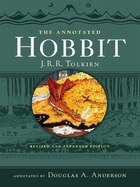
The Annotated Hobbit by J.R.R. Tolkien, with annotations by Douglas A. Anderson


The Annotated Hobbit
J.R.R. Tolkien
Annotations by Douglas A. Anderson
(Houghton Mifflin Company, Boston & New York: 2002)

The Hobbit, first published 1937.

READ: February - March 2008

The classic text of J.R.R. Tolkien's The Hobbit, with detailed annotations on the text by Douglas A. Anderson, a leading Tolkien scholar. The annotations cover everything from differences in text between various editions (and, in particular, explanations of how parts of the text were changed from the first edition to the second in order to bring some aspects of the story more in line with The Lord of the Rings), influences on Tolkien's work by other authors (Anderson is, after all, the same person who edited Tales Before Tolkien, so he has a decent grasp on the subject), and excerpts from Tolkien's own writings explaining why the story developed in certain ways. Most charming of all, however, was perhaps the inclusion and explanation of various illustrations from different foreign-language editions of The Hobbit, which, if you hadn't realized it already, really drives home the idea that The Hobbit is a true classic tale that speaks to many different cultures. A wonderful book.

Journeys of Frodo by Barbara Strachey


Journeys of Frodo : An Atlas of J.R.R. Tolkien's The Lord of the Rings
Barbara Strachey
ill. Barbara Strachey
(HarperCollins, London: 1998)

First published in Great Britain by George Allen & Unwin, 1981.

READ: February 2008

I love books.

I love maps.

I love the Lord of the Rings.

Therefore, it logically follows that were there a book of maps based on the travels in the Lord of the Rings, I would love that, too. Journeys of Frodo, happily, proves this hypothesis.

In this marvelous gem of an atlas, what Strachan has done is gone through all of J.R.R. Tolkien's writings related to the Lord of the Rings, and matched up descriptions to detailed maps. Tolkien was largely consistent in his descriptions, but he occasionally gave conflicting evidence, and in those cases, Strachan has done her best to reconcile differing accounts. While you won't find a story, per se, in the pages of this book, it is a lovely complement to anyone who wishes to have a deeper, more detailed understanding of Middle-Earth and the travels of the Fellowship.

Tales Before Tolkien : The Roots of Modern Fantasy, ed. Douglas Anderson


Tales Before Tolkien : The Roots of Modern Fantasy
Edited and with commentary by Douglas A. Anderson
(Del Rey Books (Random House), New York: 2005)

READ: January - February 2008

Douglas Anderson, a leading Tolkien scholar, has collected here 21 stories that either inspired Tolkien directly in the creation of his seminal The Hobbit and The Lord of the Rings books, or are striking examples of the lineage of prior fantasy works from which Tolkien drew inspiration.

While I understand that some sort of criteria needed to be followed in order to choose from a more finite pool of candidate stories, the selection criteria indeed seemed (as the editor himself admits) a little arbitrary: That the authors be born at least 5 years before Tolkien, not that the stories have directly influenced Tolkien. There's many other works I would have liked to see in this list, of which I have become aware from one of Anderson's other works, The Annotated Hobbit.

At any rate, as I expected to find in a work of this scope, many of the stories were wonderful little gems in their own right (for ex., The Elf Trap by Francis Stevens), while others struck me as being vastly inferior to what came later (for ex., The Golden Key by George MacDonald). Some stories were quaint and charming (for ex., Puss-cat Mew by E. Knatchbull-Hugessen), while others were simply off-beat (for ex., The Coming of the Terror by Arthur Machen).

For anyone who is a fan of fantasy literature, whether or not you are a huge fan of Tolkien, this is a book I'd recommend.

The Lord of the Rings by J.R.R. Tolkien


The Lord of the Rings
J.R.R. Tolkien
Illustrated by Alan Lee
(Houghton Mifflin, Boston: 1991)

First published in 1954 (Fellowship of the Ring).

READ: June-October 2005

I don't actually need to review this one, do I? You all know the story. If you don't - or if you've only ever seen the recent movie version - go read it. God forbid you've only seen the version by Ralph Bakshi, which I for one am trying to purge from memory (not easy to do when I see the DVD of it that I own every day). The BBC's audio dramatization, on the other hand, is good. But I don't think the musical counts.

Not for the faint-hearted, of course - my copy of the illustrated version weighs in at over 1,000 pages, plus another 200 or so pages of appendices (all necessary reading, of course). But if you've got the patience, it's a wonderful tale. And imagine the hours you can then while away debating movie-vs-book! You will wonder why Tom Bombadil was left out, and debate whether it was necessary that Glorfindel's role in the Flight to the Ford be melded into Arwen. Was Boromir as bad an anti-king, pro-ring guy as the movie tried to make him out to be, and what was the exact nature of the prophetic dream that caused him to seek Elrond"'s counsel?

Or, um, maybe that's just the kind of things I would enjoy ...

The Hobbit by J.R.R. Tolkien


The Hobbit; or, There and Back Again
J.R.R. Tolkien
(HarperCollinsPublishers, London: 1999)
Originally published in 1937 by George Allen & Unwin

READ: May 2005

This is a wonderful book. I don't think I really need to say any more, do I?

But really, The Hobbit, or There and Back Again is a marvelous tale and everyone should read it at least once, even if they're not a Lord of the Rings fan. The Hobbit was of course written about 17 years earlier, in 1937. The book tells the fantastical tale of Mr. Bilbo Baggins, a hobbit of the Shire in Middle-Earth, and how he was "persuaded" to join a troupe of dwarves out to reclaim long-lost treasures and land from Smaug, a terrible dragon. He was hired to be a thief, but he wasn't much of a thief, I'm afraid; in fact, he knew very little indeed about the profession before he set out. At just under 300 pages, The Hobbit exacts much less of a time commitment than its companion LOTR, and if you have the same edition as me, it includes the first chapter from LOTR which of course is intended to entice you to continue on to the further challenge of Tolkien's larger masterpiece.