image not available
Guide : Van Gogh Museum
from the Van Gogh Museum in Amsterdam
READ: November 2008
Bought this when we went to the Museum in 2005. It's actually in French (they were out of English copies). "The Sower", the painting I was writing a paper on for my art history course is actually on display at the van Gogh Museum, so there was some good information specifically on that particular painting. I really like museum guides generally - they are a good reminder of what I saw at the museum - and this is certainly one of the better ones.
Showing posts with label biography. Show all posts
Showing posts with label biography. Show all posts


Van Gogh by Keith Wheldon

Van Gogh
Keith Wheldon
(Smithmark Publishers, New York: 1995)
READ: October-November 2008
Again, I read this for my art history course paper. This is a giant coffee table book that a friend gave to me many years ago before moving overseas. Finally I had a reason to use it, rather than moving it from bookshelf to bookshelf in one apartment after another (bookshelves it never fit on, I might add). Wheldon looks at van Gogh's work in the larger context of contemporary art movements, and many of the works have a few pages dedicated just to critiquing (detailing) the techniques used in each one.
Discoveries: Van Gogh: The Passionate Eye by Pascal Bonafoux

Discoveries: Van Gogh: The Passionate Eye
Pascal Bonafoux
(Harry N. Abrams, New York: 1992)
READ: October-November 2008
I was writing an essay on van Gogh and, in particular, his painting "The Sower" for my art history course. I have had this book on my shelf forever. It is a detailed look at van Gogh's art and his life, including extracts from his numerous, lengthy letters to his brother, Theo, and others. While more factual than scholarly, it is a good examination of van Gogh and his particular style of Impressionism (expressionism?).
Memoirs of a Geisha by Arthur Golden

Memoirs of a Geisha
Arthur Golden
(Alfred A. Knopf, New York: 1997)
This edition published by Vintage Contemporaries, New York, 2000.
READ: March-April 2007
I haven't seen the movie, but have wanted to read the book for a while. Initially, I was confused. I had always thought that Memoirs of a Geisha was a novel, but it began with a word from a translator who claimed to have translated Sayuri's words faithfully from the Japanese. I then realized that, of course, this was part of the novel, meant to give it an added aura of authenticity.
It's a wonderful book. Nitta Sayuri, a 9-year-old girl with unusual blue-grey eyes, is not born into the world of geishas, as most are, but is taken from her small village, after her mother dies and her father can no longer care for her, and sold to a geisha house in Kyoto. This is, effectively, akin to being sold into slavery. Many girls who trained to be geisha did not succeed, managing to incur substantial debts along the way, indebting them indefinitely to the geisha house to which they belong. For Sayuri, the story is, at least at first, much the same, but as she becomes more committed to the idea of becoming a geisha, things change.
A compelling read, I hated putting the book down at the end of a chapter, always wanting to read "just one more chapter". Though sometimes I lacked sympathy for Sayuri, I could not doubt that her story was a fairly common one in Gion, the famous geisha district of Kyoto. The book also spans a key point in modern Japanese history, from the late 1920s through the 1930s, to WWII and the post-war Occupation years. Arthur Golden apparently did a fair bit of research for the book, and as far as I know, his account of what it meant to be a geisha in those days is fairly accurate. I might see the movie now, to see how it compares.
Wild Grass: China's Revolution from Below by Ian Johnson
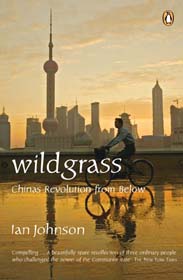
Wild Grass: China's Revolution from Below
Ian Johnson
(Penguin Group, London: 2004)
Some of the material previously appeared in a slightly different form in the Wall Street Journal .
READ: March 2007
Here's an excellent example of how a well-respected journalist should write a book based on his columns and expertise in a particular area.
Ian Johnson is a roving correspondent for the Wall Street Journal, and lived in Beijing for seven years. In his book, Wild Grass, he tells the stories of three people in China, three stories of people who tried in little ways to resist the corruption and oppression of the Communist Party. The first is a paralegal who is jailed for having helped peasants mount a legal battle against illegal taxes. Second is an architect fighting to save Beijing's historic buildings, which are being destroyed at an alarming rate. The last is a daughter who has been jailed and running into difficulties with authorities because she tried to find out answers about her mother's death in prison (where she was jailed as a Falun Gong practitioner).
I know shamefully little about China and its politics, and understand even less. I was depressed for at least two days straight after finishing this book. That being said, it was an excellent read and I strongly encourage anyone with any interest in the outside world (esp politics) to read it. Johnson knows his subject, he knows how to make a story interesting, and he knows how to make things resonate on a personal level. There were a few "of course Communism is bad and of course it is failing" moments, but overall, he does a good job of exposing the Chinese government's current weaknesses in policy and strategy without devolving too far into the land of democracy-and-market-freedom-is-great. It is well-written, and the endnotes put Thomas Friedman to shame.*
* Not that that is very hard to do.
Learned Friends by Jack Batten

Learned Friends: A Tribute to Fifty Remarkable Ontario Advocates, 1950-2000
Jack Batten
(Irwin Law, Toronto: 2005; co-published by The Advocates' Society)
READ: October 2005
At work, once or twice a week, I receive a photocopy of the front cover page of all new acquisitions received by the library, and I browse through these to see what's new and noteworthy. This was one of them, and it instantly piqued my interest. When I was an articling student a few years ago, I was recruited by a member of The Advocates' Society's editorial board to do research on 50 Ontario advocates. Sound familiar? Yup, this research was part of the initial work done on Mr. Batten's book (except he wasn't the writer I was working with at that point). I note I don't get an acknowledgement anywhere in the book, but to be fair, as an articling student I had unfortunately very little time to spend on this project and didn't get very far (though I did interview one of the lawyers profiled).
Anyway, I was pleased to see this book in the list, and searched it out at the library (we have two copies). Each of the 50 lawyers has a two-page spread detailing their life, career accomplishments, etc., with photos (young and old whenever possible). The writing is light-hearted and engaging. Some very interesting people are profiled in this book, and there are even a few women amongst the group.
And now, a professional anecdote: About a week after I finished reading Learned Friends, one of the staff at the library asked me about a reference question she'd received. A student was doing a history project about some murder trial from the 1950s and wanted to know where she could find more material. The description of the case triggered something for me, and I flipped through Learned Friends on a hunch until I realized that one of the lawyers profiled had acted for the defendant in that matter, and thus I was able to give the student some help in that respect as to where she might find more information! Neat that books actually help you out sometimes ...
Subscribe to:
Posts (Atom)