Showing posts with label science. Show all posts

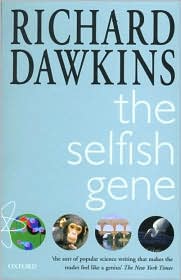
The Selfish Gene by Richard Dawkins


The Selfish Gene
Richard Dawkins
(Oxford University Press, Oxford, New York: 1989)

First published by Oxford University Press in 1976. This edition, 1989, with extensive endnotes updating the original material, as well as two new chapters.

READ: March-April 2008

Why does Richard Dawkins get such a bad name? His name is constantly being bandied about, and now that I've finally read something of his, it's a bit unfair, I think. This is an exceptional book, and really cleared up a lot for me regarding genetic theories and evolution.

I think the thrust of the misunderstanding of Dawkins, at least in regard to this book, is that people misinterpret (whether purposely or not) what he means by a "selfish gene". He doesn't believe that any one particular gene, sitting inside my body right now, is so selfish that it will do whatever it can to perpetuate itself. We would have gone extinct long ago were that the case. Obviously there is a reason that life on earth is so varied. Rather, and I am sure I am oversimplifying it here to such a degree that Dawkins would probably no longer agree with me, genes act selfish on the class level. It is classes or groups of genes that are selfish, not individual ones. And because they are selfish, they try to find the best ways to perpetuate themselves, but at the macro- not micro-level, if that makes any sense.

It's a bit daunting at first, but once you get going, his style is clear, simple, and immensely readable. It's a complex subject, but he's not afraid to take time with it and give good, concrete examples of each point. Somewhat amusingly, since this particular edition is a 1989 update of the 1976 original, he has added extensive footnotes that counterpoint arguments that have been made against his theories. He also - and this is one of the marks of a good scholar - is quick to note where his theories have since been proven incorrect, and often takes a page or two or more to elaborate a different or a concurrent theory to replace the old, incorrect one. This is probably one of the more enjoyable books that I've read so far this year.

Next by Michael Crichton


Next
Michael Crichton
(Harper (HarperCollins), New York: 2006)

READ: February 2008

I didn't have quite the visceral reaction to this book as I did to The Da Vinci Code, but almost. My mom left this book behind after coming to visit one weekend, and so I figured I'd read it.

In his book, Crichton states that Next is a work of fiction, "except for the parts that aren't." He then leads the reader through a dizzying whirlwind of genetic science events. A drug addict is cured by a gene therapy that causes accelerated maturity. A cancer patient who donated some of his cells for gene therapy to a university loses control over those cells, and those of his descendants. A monkey-boy is created when a researcher injects some of his sperm into an ape. You dream it up, Crichton's probably already put it in his book.

According to a review in the New York Times, "oddity after oddity in 'Next' checks out, and many are replays of real events." To which I respond, "Sure, but so what?" Just because something is true, doesn't make it worth reading. I've studied enough law and read just enough science to know that certain genetic procedures are still currently operating in a Wild West as far as patent law is concerned. I even agree that some, if not all, of these developments are troubling. But if you're trying to bring the issue to the forefront, why not do so in a less tabloid-esque way?

And that, I guess, is my main problem with this book. Fundamentally, I can agree with Crichton's main thesis. A novel with a thesis, you may ask? While certainly not every work of fiction can be said to have a central thesis, in an Author's Note to Next, just in case you didn't "get it", Crichton clearly lays out his five conclusions:

1) Stop patenting genes.
2) Establish clear guidelines for the use of human tissues.
3) Pass laws to ensure that data about gene testing is made public.
4) Avoid bans on research.
5) Rescind the Bayh-Dole Act [which grants universities, small businesses, and non-profit institutions in the U.S. the control and ownership of any intellectual property on inventions resulting from federal government-funded research, rather than the IP rights going to the government].

On their face, these are laudable goals. And a novel, of course, does not have to be neutral in its politics. However, I find Crichton's method of hammering the reader over the head with example after example of why our current legislative scheme (or lack thereof) is faulty, to be tedious, deplorable, and even somewhat insulting. Next is geared to prove that these five conclusions are inevitable. While this may or may not be true, a proper exploration of the issues would have been more appropriate. A proper exploration could very well, in fact, lead to the same five conclusions, but without me feeling like I've been dragged through 300+ pages of bias to get there, leaving me a happier reader as a result, and perhaps more concerned about the issues.

But Next dismisses any need for a proper debate. It says, "It's so obvious," and then throws 37 different examples my way. It portrays the guys (yes, mostly guys) in the biotechnology business as cowboys, bent on getting the results they want at any cost. Everything is black and white. Even those issues that could have been dealt with more subtly are painted with fat brushstrokes: Alex - whose father is the cancer patient mentioned above whose cells, and those of his descendants, are now "owned", as it were, by the university who developed a particular gene therapy - is a lawyer. But wait! - she's not a blood-sucking, money-leaching lawyer, like all the others in the book. She is nice and cuddly, and prefers to settle matters out-of-court whenever possible, rather than dragging everything out into a prolonged court fight. She only starts to get mean when her son is threatened. I mean, c'mon - it's her son! And then there's David, the 4-year-old "monkey-boy", who is rescued by the researcher who created him when it turns out David is scheduled for termination (due to the lab being worried about the ethical ramifications that may arise if David's existence is discovered, though why that hadn't happened earlier when David first started showing signs of being anything other than a regular ape is a good question, but I digress). He is brought to live with the researcher's family in California, and things only come to a head when another young boy starts challenging David. But this boy is not just your average neighbourhood bully, not just that kid who didn't get enough hugs from his mother when he was very young - oh, no, this kid is mean, escalating from a brief schoolyard scuffle to an actual gunfight in the blink of an eye. Shed no tears for the bully; David needs them all.

Crichton dumbs down the issue by using such broad, obvious strokes. In addition, the style of the book, with its short, fast-paced chapters, cutting from storyline to story line, and interspersed fake news articles written to look as if they are real, further debases the actual importance of these issues. Really, all I ever needed to know about cloning, I did not learn from Jurassic Park (to be fair, I have not read the book), and I am dismayed at the thought that people will think they have "learned" about genetic testing from Next.

Final thought: For an example of how to rewrite Next - even in such a way that it has almost exactly the same plotlines - but with less bias and more exploration of actual issues rather than the panic-stricken tone adopted here, take a look at Neal Stephenson's Cryptonomicon. In it, Stephenson clearly and concisely sets out the history of cryptography, and also explores future possible developments of the technology of cryptography, both good and bad. It's a big book, and will take you longer than 3 days to read (which is roughly how long it took me to get through Next, mostly while commuting to and from work), but there are certainly worse things on which you could waste brain-cells and time.
A Short History of Nearly Everything by Bill Bryson


A Short History of Nearly Everything
Bill Bryson
(Anchor Canada (Random House), Toronto?: 2004)

READ: November 2007

I'd been wanting to read this book for months now, and boy, was it worth the wait. In his Short History, Bryson explains everything from the beginnings of life on our planet, to astrophysics, natural disasters, dinosaurs, and Einstein's theory of relativity, in plain, simple language. Well-known as a travel writer, Bryson brings his particular brand of humour to these, and many other questions of scientific import. Entertaining and elucidating, it's one of those books I should have taken notes on while reading. Well-documented, and well-thought out, this is one of the most entertaining and informative reads I've had in a while. My first Bryson book, but definitely not my last.

Krakatoa: The Day The World Exploded: August 27, 1883 by Simon Winchester


Krakatoa: The Day The World Exploded: August 27, 1883
Simon Winchester
(HarperCollins, New York: 2003)

First published by Viking, Great Britain: 2003.

READ: July-August 2007

I've said this before, and I'll say it again: Winchester could make the phone book interesting, I swear.

While not quite as entertaining as A Crack in the Edge of the World, Krakatoa is a fascinating look into the insides of this infamous Indonesian volcano, and the devastation it wrought over 100 years ago. As a trained geologist, Winchester knows what he's talking about, and as a trained journalist, he knows how to make his story interesting. The story was hard to initially piece together, and Winchester has done a formidable job. It was the first modern volcanic explosion of such a ferocious magnitude. Vulcanologists (yes, they are really called that) didn't really exist yet, and those geologists who did have an interest in volcanoes didn't really know what made them tick. There were also very few survivors, and virtually no eyewitness accounts. Furthermore, while very few people actually died as a direct result of the volcanic explosion itself (Krakatoa was a volcanic island unto itself, so there was no Pompeii villagers waiting to be buried), the death toll skyrocketed after a series of devastating tsunamis hit the surrounding Javan and Sumatran shores. We don't even understand tsunamis today, let alone back in 1883. Beyond the actual devastation, of course, is the science of why it all happened - why did Krakatoa explode? - and that is where Winchester, like he did in A Crack in the Edge of the World, truly shines. If plate tectonics and the inner workings of the mantle core had been presented to me in such an interesting manner back in my early school days, I might have chosen a quite different career.

A History of Western Science by Anthony Alioto


A History of Western Science
Anthony Alioto
(Pearson Education Canada, Toronto: 1992)

READ: July 2005 (incomplete)

I didn't finish this one either, but don't blame it on the book - blame it on the reader. This is actually a text used in introductory science courses at university ("science for arts students", if you know what I mean). It can be a little dry at times, but mostly it is actually quite interesting. I didn't make it very far - up to the end of the Greeks, if I remember correctly - so all I can do is repeat over and over that "it is actually quite interesting." It is well-written and explains much of the history and workings of science in fairly plain language. I've shelved it for now, but I do plan on returning to it someday. I only know the very basic outlines of science's history, and with some of the other books I've been reading, I'd certainly like to learn more. But sometimes, you're just not ready to tackle a book, and Western Science, today was not your day. (To be fair, part of the problem is that this was the book I accidentally dropped behind my bookcase, and it took a few weeks to fish it out again, by which point I had completely and utterly lost any desire to continue reading it.)

Hyperspace by Michio Kaku


Hyperspace : A Scientific Odyssey Through Parallel Universes, Time Warps, and the 10th Dimension
by Michio Kaku
(Anchor Books, New York: 1995)

READ: January-February 2005

A great book. Definitely a must-read. It's been a while since I last picked up a science book of any kind, but I've become interested more and more in learning about this sort of thing. Over Christmas, a great programme aired on Nova on PBS, called The Elegant Universe, which surveyed the development of multiple dimensions and string theory in the realm of (largely) theoretical physics (also a book, which I intend to read sometime soon as well). I missed it over Christmas (visiting family, etc.), but the programme is available online, and I highly recommend it.

Anyway, it's definitely nerdy of me, but it's a field I find interesting (and one in which I have absolutely no training). I haven't taken a physics class since grade 10 (Secondaire IV for all you hard-core Québecers in the crowd). So I resolved to read it in order to better understand the Nova programme. In clear, simple language, Michio Kaku, a professor of theoretical physics at the City College of the City University of New York, outlines the history of the development of the theory of hyperspace. In a nutshell, things are simpler to understand when expressed in higher dimensions. He gives the (commonly-used) example of someone who is flat and lives in a flat, two-dimensional world. To such a Flatlander, a three-dimensional object would not make sense, as it would never remain constant from second to second. For example, if a 3-D apple were to fall onto the Flatlander's world, a Flatlander could only view it in segmented 2-D slices. Brown lines representing the apple stem. Then red or green lines, changing rapidly, first growing larger then smaller, as the apple passes "through" his world. A Flatlander cannot think in 3-D since there is no way to represent this in his world. We have the same problem living in our three-dimensional world, but it is generally accepted that there are at least four dimensions (the three familiar ones of space, and the fourth of time as posited by Einstein), with the possibility of a fifth (a space-time dimension). However, for hyperspace to be feasible, there are, in fact, many more dimensions - likely 10 or 11. (Some superstring theories, which is related to hyperspace, suggest as many as 26!)

Anyway, a good read for anyone who's wondered about physics but was too scared to ask, as it were. Simple language, good explanations, very interesting.